by Michaela Sharp | Oct 1, 2026 | Blog, Dalilu Wire, Marketing, Media Buying, Media Planning
What a gas station stop reminded me about advertising, media and memory recall.
We were on our way to the lake when we stopped for gas. Nothing unusual about that. We have
made that drive many times, and a gas station somewhere along the highway in Northwestern Ontario is not exactly where I expect to find a marketing lesson.
But there it was: a little vintage red Ford truck.
It wasn’t advertising anything to me. There wasn’t a campaign behind it, a headline, a call to action or
a media plan. It was simply parked there, and I noticed it immediately.
The colour. The shape. The simplicity of it.
For somebody who has spent more than 25 years thinking about what makes people notice things,
that is difficult to ignore. Sometimes the best marketing lessons really do show up in unexpected
places.
Before people can remember us, they have to notice us.
And maybe that is partly why I keep noticing these things myself. Lately, I seem to be finding little
marketing and advertising lessons everywhere in places, objects and ordinary moments around
me. Heck, I might be doing exactly that right now.
Distinctiveness Comes First
We talk a lot about frequency in media. How many times should somebody see an ad? How much
reach do we need? How much frequency should we build before the campaign begins to wear out?
Those are important questions. I ask them constantly.
But frequency has to have something to work with.
That little red truck did not need five exposures before I noticed it. One was enough. It stood apart
from everything surrounding it.
That does not mean brands should abandon frequency. Quite the opposite. Repetition matters
because it helps reinforce something that has already begun forming in somebody’s memory. But
repetition cannot rescue something people barely noticed in the first place.
Good frequency should reinforce memory, not manufacture it from scratch.
That distinction matters. We can serve an ad eight times and technically achieve our frequency goal,
but if every exposure is visually interchangeable with everything else the audience is seeing, what
exactly are we reinforcing?
An impression count tells us an ad was delivered. It does not tell us whether anything stayed behind.
And Then There is the Colour
Imagine the exact same truck in black. Or white. Or silver. Colours we see on so many vehicles
today.
It would still be a beautiful old truck. But would I have noticed it in quite the same way?
Probably not.
And I definitely do not think I would be sitting on my couch late on a Wednesday evening writing an
article about it. I would probably be watching TV instead, not thinking about marketing at all.
The red separated the truck from everything around it. That is what distinctiveness can do for a brand too. It gives the eye somewhere to go and gives memory something to hold onto.
The truck was not trying to be subtle. And maybe that is part of why it worked on me.
Sometimes the Answer is Less
Advertising has a strange habit of accumulating things: one more benefit, one more offer, one more
feature, one more sentence, one more disclaimer.
Eventually, we have asked one piece of creative to do the work of an entire brochure. Then we
wonder why nothing stands out.
The truck was almost the opposite. There was not very much to process. Its colour and shape did
most of the work.
Creative does not always need more. Sometimes it needs room and boldness.
And that can be surprisingly hard for marketers. We get nervous about putting all of our gems in one
bold basket. We start thinking: what if this other idea works too? Maybe we should keep both. Or
three. Just in case.
Before long, instead of choosing the strongest idea, we are asking several ideas to compete inside
the same piece of creative.
Or worse, we introduce three, sometimes even more, different creative executions because none
of them feels bold enough to carry the campaign on its own.
And this is where I may sound a little critical.
I do wonder whether we have become more cautious about pushing creative boundaries. At least in
the market I work in, I see a lot of perfectly competent work that feels safe.
Maybe that is partly because making one strong choice feels risky. Sometimes it is simply easier to
play it safe. Safer work usually needs less defending, less explaining and less selling internally or to
the client.
But there is an irony in that.
If the idea is genuinely strong, clear and bold, maybe it should not need that much selling in the first
place. People should be able to see what makes it work.
And when we choose safety because it is easier to approve, we may also be choosing something
easier to ignore.
By trying not to make the wrong choice, we can end up avoiding a memorable one.
That, to me, is the bigger risk.
The Environment Did Half the Work
There was another reason the truck caught my attention: where it was.
Imagine that exact same truck parked at a vintage Ford show between twenty other beautifully
restored red trucks. Would it have stood out in the same way?
Probably not.
At that gas station, surrounded by ordinary vehicles, fuel pumps, highway signs, trees and the
scenery of Northwestern Ontario, it became the thing my eye went toward.
The truck had not changed. Its context had.
That is an important media-planning lesson.
Placement is not simply about finding somewhere an advertisement can appear. The environment
changes how the advertising is experienced.
A beautiful thirty-second video on a television screen in someone’s living room is experienced
differently from the same idea squeezed into a small placement somebody scrolls past on a phone. A
message encountered while somebody is actively looking for an answer behaves differently from a
message appearing while they are relaxing and watching entertainment.
Even excellent creative can struggle in the wrong environment.
Strong creative gives people something worth noticing. Media gives it the right place to be noticed.
That is why I have never thought of media planning as simply buying available inventory. It is about
choosing the environment where the message has the best chance to do its job.
We are choosing where an idea gets its chance.
And Then Frequency Gets to Do its Job
Which brings me back to frequency.
I am probably never going to stop talking about it.
Especially in digital media, I see campaigns spread so thinly across audiences, platforms and tactics that people may barely encounter the advertising before the campaign disappears.
One exposure is rarely enough to build memory recall.
But there is an important sequence here: first, give people something worth noticing. Then put it in an environment where it has a chance to be noticed. Then give people enough opportunities to encounter it again.
That is very different from simply delivering the same unremarkable impression over and over.
Frequency is not the idea. Frequency supports the idea.
And when the creative is distinctive, the message is clear and the environment makes sense,
repetition starts doing exactly what we want it to do: reinforcing memory.
The first encounter made that truck noticeable. Another encounter would make it more familiar. Another might make it easier to recall.
But none of those later encounters would matter very much if the first one had given me nothing worth remembering.
Maybe That is Why I Photographed the Truck
I did not know I was going to write about advertising when I pulled out my phone. I just liked the truck. Nobody asked for my attention. Nothing interrupted me. There was simply something distinctive enough in the environment that I wanted to look at it.
And maybe that says something about me too.
I pay a lot of attention to details. I notice colours, shapes, old buildings, signs, light, landscapes and tiny things other people might walk right past. I get inspired easily. I get in awe of things easily too. I often joke with my husband, Grant, that his world seems much simpler than mine. He can look at a place and just see the place.
Me? Oh boy.
My world is full of distractions. Beautiful distractions. Things that pull my eye, make me stop, make me wonder and make me think.
Sometimes it can be a little overwhelming, but I honestly would not want it any other way.
Because every once in a while, one of those distractions turns into an idea.
Or, apparently, an entire article about a little red truck at a gas station in Northwestern Ontario.

by Michaela Sharp | Sep 18, 2026 | Dalilu Wire, Digital, Marketing, Media Planning, Personal
When I began working in media more than 25 years ago, I could never have imagined where this career would take me.
Today, my work at Dalilu Communications spans traditional and digital media strategy, programmatic advertising and integrated campaigns. Somewhere along the way, I also added filming, video editing and figuring out what makes people stop scrolling on social media to the list.
Phew! Some days, I wonder what I will tackle next.
The media world has changed dramatically since I started, and in many ways, so have I.
Some of those changes came naturally. Others made me feel like a complete beginner again.
Looking back, I realize that staying relevant has never meant knowing everything or following every new trend. For me, it has meant being willing to learn, adapt and occasionally feel uncomfortable.
It has also meant recognizing that while the tools keep changing, many of the fundamentals do not.
The Questions That Still Matter
When I worked primarily in television media buying, we asked who we wanted to reach, when they were watching and how to use our clients’ available budgets effectively.
Today, we have far more platforms, formats and data, but we are still trying to understand people.
- Who are we speaking to?
- What matters to them?
- Where can we reach them organically?
- What do we hope they will think, feel or do?
The answers may lead us to television, social media, search, video or a combination of channels. But the starting point should not be the newest platform. It should be a clear understanding of the audience and the purpose behind the message.
My years in media have taught me an important lesson: new tools do not replace good thinking. They simply give us new ways to put it into practice.
Learning to Begin Again
Moving from Europe to Canada was one of the first times I had to learn how to carry my experience into a completely new environment.
I arrived with professional knowledge, but I did not yet know the Canadian media market. The companies and audiences were different, and the relationships I had built throughout my career had to be established again.
That experience taught me that having knowledge does not mean you have nothing left to learn.
Over time, I expanded beyond television into radio, print, out-of-home, digital advertising, search engine marketing, paid social media, programmatic media and campaign analytics.
With every new area, part of my previous experience remained useful, but I also had to ask questions, listen and accept that I would not understand everything immediately.
Starting again can be humbling. It can also remind us how capable we are of growing.
Building Something of Our Own
In 2015, after the birth of our third child, I was preparing to return from maternity leave. However, my employer could not offer me enough hours to meet our family’s needs. Around the same time, several former coworkers approached me and asked whether I would be willing to help them with their media planning.
Their questions made me realize that there might be an opportunity to build something of our own. I began thinking seriously about starting a company with my husband, Grant. It would mean giving him a fast-paced introduction to everything I had learned throughout my media career, but I knew he was more than capable. Grant is extremely bright, and I trusted that he would learn quickly.
Together, we founded Dalilu Communications. Starting the company gave us the opportunity to work more directly with clients and create greater flexibility for our family. It brought freedom, but it also brought uncertainty, responsibility and another long list of things for both of us to learn.
Why Clarity Matters
Most clients are not looking for more jargon. They are looking for clarity.
They want to understand where their money is going, why a particular approach makes sense and whether it is helping them move closer to their goals.
The media landscape may be more complicated than ever, but our responsibility should be to make marketing decisions easier to understand.
Seeing Marketing From the Creator’s Side
More recently, I challenged myself in a completely different way by becoming a content creator.
I now create content for Dalilu Adventures, Partridge Point and Mezi Javory. I film, edit, write narration with a help of AI, add subtitles and adapt stories for YouTube, Instagram, Facebook or TikTok.
Mezi Javory has become an especially meaningful project for me. Through this Czech-language channel, I share my life in Canada as a Czech immigrant, a woman over 50, a mother, a wife and a working professional.
I started with stories I wanted to tell. Then I had to learn how to tell them.
There have been many moments when the technology did not cooperate, an edit took much longer than expected or a video that required hours of work received very little attention. There have also been encouraging moments when a story connected with someone I had never met.
Creating content myself has helped me understand marketing from a different perspective.
Behind every short video is an idea, a series of decisions and often far more work than the viewer will ever see. Capturing attention matters, but building a genuine connection requires something more: consistency, authenticity and respect for the audience.
This experience has also reminded me that learning does not always feel graceful. Sometimes it involves experimenting, making mistakes and being willing to publish something before it feels perfect.
The Value of Experience and Curiosity
There is sometimes an assumption that experience and innovation are opposites. That people with long careers become set in their ways while new ideas belong to younger generations.
I do not believe that has to be true.
Experience helps us recognize patterns, anticipate challenges and ask better questions. Curiosity prevents that experience from becoming a limitation.
The two belong together.
Staying relevant does not require chasing every trend or pretending to be an expert on every platform. It requires paying attention to what is changing, remembering what still matters and being willing to adjust.
Now that I am over 50, I see my age and experience as advantages. I have decades of knowledge to draw from when clients invite us to partner with them on exciting projects. At the same time, I know that experience alone is not enough. We must remain open to new ideas, new technology and new ways of thinking.
At this stage of my life, I do not find myself counting down to retirement or imagining the day when I will stop doing what I do. I simply keep moving forward working, learning and embracing the experiences that come with each new project.
For me, making the most of this stage of life means continuing to grow rather than stepping back. Staying curious, remaining relevant and never assuming that I have learned everything are key. I may have many years of experience behind me, but I am still excited about what I have yet to discover.
After more than 25 years in media, these are the lessons I keep returning to:
- Strategy should come before tactics.
- Understanding people, matters more than mastering any single platform.
- Experience becomes more valuable when it remains flexible.
- Feeling like a beginner is not a weakness; it is often a sign that we are growing.
- We are never too experienced, or too old to learn something new.
- Staying relevant begins with staying curious.
When I began my career, I could not have predicted the media landscape we have today. I certainly cannot predict what it will look like ten years from now.
But perhaps predicting every change is not necessary.
What matters is remaining willing to listen, learn and adapt. When we do that, our experience does not become outdated. It becomes the foundation that helps us take the next step even when that step leads somewhere we never expected.

by Michaela Sharp | Sep 18, 2026 | Dalilu Wire, Marketing, Media Planning
A media plan should do more than list channels, dates and budgets.
It should connect strategy with execution, help everyone involved understand the campaign and make the next steps clear. A client should be able to see where the budget is going. A media buyer should know what needs to be booked. A designer should be able to identify the required creative assets. A campaign manager should understand the timing, responsibilities and reporting expectations.
When this information is organized effectively, the plan may appear simple. That simplicity, however, should not be mistaken for a lack of strategic thinking.
The real test of a media plan is not how impressive it looks when presented. It is how useful it remains once the work begins.
A media plan should be a working document
Some media plans function primarily as presentation documents. They describe the strategy, introduce the selected channels and explain why the recommendations make sense. That information is important, but it may not be enough to guide the campaign through execution.
Once a campaign is approved, practical questions begin to appear. If the answers are scattered across presentations, spreadsheets, emails and meeting notes, the media plan may be creating more work than it prevents.
A useful plan brings the essential information together and becomes a reliable reference throughout the campaign.
-
What needs to be booked and when each tactic will run
-
Which creative assets are required and when they are due
-
How the budget is divided
-
Which markets and audiences are being targeted
-
What will be needed for reporting
-
Where changes and approvals will be recorded
Problem 1: Strategy and execution are separated
A written strategy may explain why certain channels were selected, while a separate spreadsheet lists costs and dates. Creative requirements may be sent by email, and later changes may live in meeting notes. Each document may be accurate, but the people responsible for the campaign must piece the information together themselves.
A better approach is to create one central planning document that connects the strategic recommendation with the details required for execution. Not every explanation needs to fit into one chart, but the central plan should show how the major decisions connect.
-
Campaign objective and intended audience
-
The role of each media tactic
-
Campaign dates and budget allocations
-
Markets, targeting and placement details
-
Creative requirements and deadlines
-
Responsibilities and important campaign notes
Problem 2: The plan makes sense only to its creator
Media planners work with campaign charts regularly. Their structure, abbreviations and colour coding may feel completely natural to the person who created them. Other readers may review only a few media plans each year.
When a client or colleague asks about information already contained in the plan, it is easy to assume they did not read it carefully. Repeated questions, however, may indicate that the information is not as easy to find or interpret as intended.
Review the plan from the perspective of someone encountering it for the first time. A walkthrough may still be valuable, but the document should not depend completely on its creator to make sense.
-
Explain abbreviations
-
Make important numbers easy to locate
-
Distinguish proposed activity from confirmed activity
-
Use colour and formatting consistently
-
Make revisions visible
-
Ensure each person can find information relevant to their role
Problem 3: Responsibilities are implied rather than assigned
A media plan may show what needs to happen without identifying who is responsible for making it happen. Everyone may assume that someone else is confirming the booking, supplying the creative, approving the copy or checking the tracking setup. The missing task often becomes visible only when a deadline is approaching.
Connect important actions with clear ownership. A few clearly labelled columns can prevent uncertainty and unnecessary follow-up without turning the media plan into an elaborate project-management system.
-
What is needed
-
Who is responsible
-
When it is due
-
Whether it has been completed
Problem 4: Creative requirements are added too late
A campaign may be strategically sound and properly budgeted but still encounter delays because creative requirements were not considered early enough. Ad sizes, video lengths, file formats, copy limits and platform specifications affect production timelines.
Include creative requirements as soon as the tactic is added to the plan. If specifications frequently change, link to the current source rather than copying information that may become outdated. The goal is to make the requirement easy to access when it is needed.
-
Required assets and formats
-
Copy and technical requirements
-
Submission and approval deadlines
-
A current production-guidelines link
Problem 5: The budget is present but difficult to follow
A spreadsheet may contain every cost while still making it difficult to understand the overall investment. Readers should not need to perform their own calculations to determine how much is allocated to each channel, market or campaign phase.
Organize the budget so readers can move easily between details and the complete picture. The figures should also reconcile before the plan is distributed.
-
Cost by media tactic, market or campaign period
-
Fees and taxes
-
Subtotals and total campaign investment
Problem 6: Changes are difficult to identify
Media plans rarely remain completely unchanged. Inventory may become unavailable, dates may move, budgets may be adjusted and new opportunities may appear. Without clear version control, different people may begin working from different plans.
When a revised plan is distributed, indicate what changed. Do not expect readers to compare two detailed documents line by line to discover the difference.
-
Creation date and last-updated date
-
Version number or status
-
Proposed, approved, booked or completed status
-
Notes explaining significant changes
Problem 7: The plan ends at approval
The planning document is often treated as finished once the campaign launches. Months later, someone must compare the original recommendation with what was delivered and how it performed. If the plan does not preserve the necessary context, reporting and invoice reconciliation become more difficult.
Build the plan with the complete campaign cycle in mind: Plan. Execute. Optimize. Review. The plan does not need to contain the complete final report, but it should provide a reliable foundation for creating it.
-
Original and revised budgets
-
Planned and actual campaign dates
-
Booked placements and delivery expectations
-
Performance and optimization notes
-
Final costs and invoice references
-
Explanations for major changes
How much information is enough?
A media plan can also become difficult to use when it contains too much information. The objective is not to place every available detail into one document. It is to include the information people need to make decisions and complete their responsibilities.
Information should be included because it improves execution, not because it demonstrates how much the planner knows.
-
Who needs this information?
-
What will they do with it?
-
When will they need it?
-
Does it belong in the central plan, an attachment or a linked resource?
A practical media-plan checklist
Strategy
-
Is the objective clear?
-
Is the intended audience identified?
-
Does each tactic have a defined role?
-
Can readers understand how the recommendation supports the objective?
Budget and timing
-
Are costs easy to locate and understand?
-
Do the details match the total?
-
Are campaign, booking, creative and approval dates shown?
-
Are dependencies between tasks visible?
Execution
-
Does each important action have an owner?
-
Are creative requirements accessible?
-
Can every participant find what they need?
-
Is the current status of each tactic clear?
Document management
-
Is the current version clearly identified?
-
Are significant revisions explained?
-
Is there one recognized source of current information?
-
Will the plan still support reporting and reconciliation later?
Simplicity is an outcome
A one-page media plan can contain the result of hours of research, comparison, calculation and decision-making. Its purpose is not to display all that effort. Its purpose is to translate the work into something other people can understand and use.
A clear plan reduces uncertainty. It connects the people responsible for strategy, buying, creative production, campaign management and approval. It also helps identify missing information before that information becomes a problem.
The complexity has not disappeared. It has been organized. That is what a useful media plan should actually do.

by Michaela Sharp | Sep 18, 2026 | Dalilu Wire, Marketing, Media Planning
I have always liked taking photos whenever I can, especially when we travel. During a recent visit with family in the Czech Republic, I took the kids and my husband Grant to a museum we all became very fond of and came home with far too many photos. Looking through them later, I started noticing how many of the displays echoed ideas I think about every day in marketing.
Museum/Family Story
What pulls us in?
When we first arrived at the museum, we walked in together.
That lasted about five minutes.
As soon as we entered the first exhibit, we all started drifting in different directions. One of the kids would stop at something on one side of the room, someone else would disappear around the corner, and I would usually find myself somewhere in between, taking photos.
Every so often, we would find each other again. Someone would call the others over because they had found something interesting, learned something unexpected, or simply seen something they thought the rest of us needed to see. Sometimes whatever they had found was compelling enough that the rest of us would leave what we were looking at and gather around it together.
I did not think much about that at the time. But when I looked through my photographs later, I started wondering why certain things had pulled us in while others had not.
In a museum, there is a lot to look at, but your attention does not move randomly from one object to the next. Certain things catch you first. Sometimes it is the lighting. Sometimes it is the amount of space around an object. Sometimes it is simply where something has been positioned in relation to everything else around it.
Someone has already made decisions about what deserves attention first, what should support it and what can wait quietly in the background until you are ready to notice it.
That made me think about advertising.
When everything starts to feel important
When we work closely with a brand, it is very easy for everything to start feeling important. The offer matters, the product benefit matters, the logo matters, the call to action matters and the supporting information matters too. Of course it does.
But the audience does not experience those things from inside the business. They may see the ad for only a few seconds, perhaps while doing something else entirely and they have to work out very quickly where to look and what matters.
“Communication becomes easier to follow when everything is not given the same weight. The audience needs a clear place to begin.”
I think that is what the museum made so visible to me.
A display does not necessarily need less information. It needs some sense of order. Your eye lands somewhere first, and from there the rest of the story has a chance to unfold.
Distinctiveness plays a role in that too. It is not always about being louder or more dramatic than everything around you. Sometimes it is simply about creating a clear enough cue that the eye knows where to land.
Where should the audience begin?
The same principle carries into media planning. Not every channel needs to carry the entire campaign. One may introduce the idea, another may build familiarity, while another may reach someone when they are ready to act. When every tactic is expected to do everything, the plan can become just as difficult to follow as creative where everything is competing for attention at once.
Looking back, I find it interesting that we all entered the museum together and almost immediately went our separate ways. Our attention took us in different directions. But every so often, something was strong enough to pull us back together.
And perhaps that is the more interesting question for marketers. Not simply, “Did they see it?” But: Was there something there worth stopping for or even calling someone else over to see?

by Grant Sharp | Jun 20, 2017 | Blog, Digital, Marketing, Media Planning
Why Dalilu?
Did you know we do Programmatic Advertising?
Programmatic Advertising is a relatively new addition to our company’s portfolio of services. Although we have personally been planning and executing digital campaigns for years, we recently became frustrated with some of our supplier’s lack of attention to detail. This frustration led to our company partnering with Centro, one of the industries best known and well-established companies. This partnership has given us full access to their demand side platform on a self-serve basis.
Being self-serve means that we have a full control of how a campaign is run. In other words, we have the ability to optimize campaigns in-house, in real-time without relying exclusively on data focussed third parties out of Toronto, Montreal, Boston or Chicago who don’t know the subtleties of our local market.
Isn’t Data a good thing?
Don’t get us wrong, we love data as much as the next person. However, our years of experience in traditional media have shown us that while data is an extremely valuable component of how media is bought (digital or otherwise), context should always be taken into consideration along with the data. This is as true today as it was 20 years ago when Michaela was trained to buy TV in Prague for Unilever and L’Oreal. Effectively, this is something that many Programmatic companies gloss over due to scale.
What does this mean for you?
Essentially, this means that we can run any campaign that your objectives require. This includes:
- Audience Campaigns;
- Data Campaigns;
- Hyper Local Campaigns;
- Mobile App Campaigns;
- Video Campaigns;
- Native Ads Campaign;
- White-listed Campaigns and more.
For more information, please check out our recent post 8 digital display campaign tactics that every Winnipeg marketer should use in 2017.
Over the past 6 months, we have been running Programmatic campaigns for St. Vital Centre, Holiday Inn Airport West, and most recently the CPHR Canada. This campaign had 6 different conversions to measure and included retargeting. We targeted each province separately and used 5 different campaign tactics. It was a blast to work on it!
Looking for something else? Here are some of our other services?
As mentioned above, the scope of our services goes far beyond digital media. Having planned and bought traditional media for over 20 years, our team has plenty of national, international and local experience in this field.
Here are additional details about some of our other services:
Whether you are in need of a local digital campaign delivered with finesse, or a broad scale Brand awareness campaign delivered across either Traditional or Digital platforms, Dalilu has the experience, expertise, and attention to detail necessary to make your next campaign a success!

by Michaela Sharp | Jun 7, 2017 | Blog, Digital, Marketing, Media Planning, Web
The slowly shaping path of content access and our digital devices
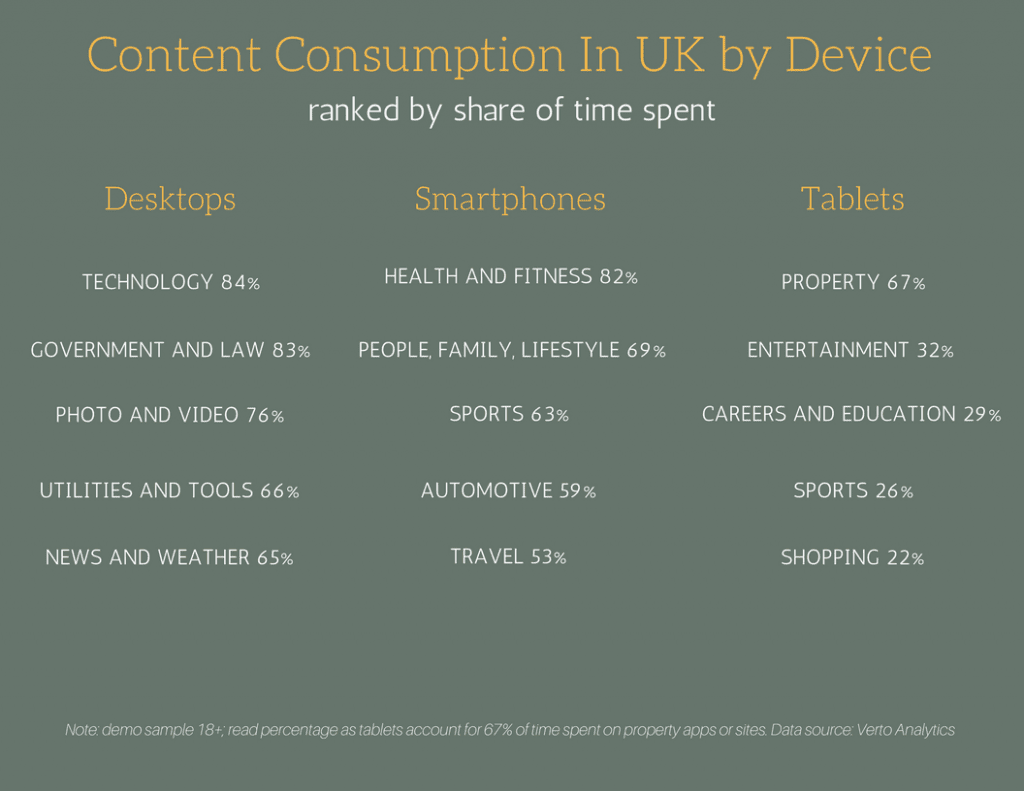
Have you ever wondered if there is a difference in what content you are accessing from which device? As a marketer, this is a fascinating question. And it turns out, we were not the only one’s asking. Recently, a study was done in the United Kingdom. Interestingly, it covered the connection between device type usage and content and may start to answer this question.
Does the device we are using influence what we read?
According to Verto Analytics, a company specializing in analytics and data research, there are some clear indications of how and what we read on our devices. Verto tracked devices of approximately 5,000 people in March of this year.
What they came up is very interesting. Apparently smart phones are frequently used for sports, health and fitness, automotive and travel. Addtionally, they are also used for people/family/lifestyle, which would includes recipes, food or parenting. By comparison, we use desktops for browsing on technology sites, government and law, news and weather or photo and video. Lastly, the tablet devices are mainly used for property, entertainment, careers, education, sports and lastly shopping.
Things are not always as they seem
As you can see, it is not always black and white in digital. Not all brands need to advertise on cross platform devices. However, some activities such as entertainment remains as multi-device content. People are accessing information from their tablets 32%, smartphones usage is up to 39% and desktops contributed 29% in this mix.
According to a recent eMarketer article, Verto’s data is very similar to the ComScore data that was released in December 2016. Which is enough to say there is a pattern. As advertisers, it is important to learn from findings like these, when planning our next digital campaign.